Introduction
The need for medical professionals, including radiation oncologists, to receive education on climate change and its associated impacts on health care is becoming increasingly evident. 1 The rise of extreme weather events linked to climate change is known to disrupt radiation therapy delivery through power outages, damage to crucial infrastructure, and interruptions in transportation networks, thereby adversely affecting patient outcomes, particularly in vulnerable groups such as the elderly and socioeconomically disadvantaged populations. 2-6 Furthermore, these climate-induced changes contribute to the proliferation of diseases and jeopardize essential resources like food and water supplies, as well as access to health care services. 7,8 Recent studies have found that 80% of health care workers, including those in radiation oncology, are urging their employers to prioritize sustainable and environmentally conscious practices. 9 However, 41% of physicians feel ill-prepared to discuss climate change with patients, highlighting a significant knowledge gap and emphasizing the urgency for educational initiatives in this domain. 10
Efforts to incorporate climate change material into graduate medical education (GME) have been gaining traction across various fields nationally and internationally. 11-15 In June 2019, the American Medical Association (AMA) released a policy statement supporting the inclusion of climate change content throughout GME. 16 Despite the AMA’s support for such initiatives, a notable gap remains within the field of radiation oncology. 17
Our aim was to evaluate the perspectives of US and Canadian radiation oncology program directors (PDs) and associate program directors (APDs) on climate change and sustainability education, as well as its impact on health care. Furthermore, this survey aims to identify both barriers and facilitators to implementing climate change education in these programs, potentially highlighting effective strategies for its incorporation. In doing so, this study seeks to foster a new generation of radiation oncologists who have the knowledge and skills to effectively address and adapt to the challenges climate change poses. 18
Materials and Methods
Study Population
The study focused on radiation oncology PDs and APDs in the United States and Canada. This group was chosen given their historical role in developing GME and continuing medical education (CME). The University of California San Francisco and Michigan State University Institutional Review Boards approved this study as exempt.
Survey Development
The survey was developed referencing published studies focusing on understanding perspectives on climate change and education initiatives. 12-14,19-22 Survey questions fell into 3 main categories: climate change education and its integration into radiation oncology residency curricula, knowledge and beliefs about climate change and sustainability, and perceptions of climate change’s impact on clinical practice and patient care (see Supplementary Appendix for details [available in the online version of this article at www.appliedradiationoncology.com ]). Basic demographic information, including participants’ gender and location, was also collected. The survey was piloted with 10 experts in radiation oncology, education, and climate science to improve the clarity, relevance, and structure of the questions.
The final survey comprised 15 items, including a 5-point Likert-type scale, multiple-choice, and open-ended questions. The 5-point Likert-type scale, which ranged from 1 (strongly disagree) to 5 (strongly agree), assessed 10 questions across 3 main categories detailed in the Supplementary Appendix (available in the online version of this article at www.appliedradiationoncology.com ). Definitions of key terms were provided (see Supplementary Appendix) to ensure a uniform understanding. The survey was emailed to 114 PDs and APDs in the United States (n=101) and Canada (n = 13). Participants were allotted 1 month to complete the survey, during which time 2 additional reminders were sent. No incentives were offered. The survey was administered through Qualtrics digital software version XM ©2020, and all data collected were anonymized. In accordance with institutional review board guidelines, participants were not obliged to answer every question.
Data Analysis
Descriptive statistics (mean and standard deviation [SD]) were calculated to summarize the characteristics of participants and question responses. To investigate the differences in response patterns based on exposure to climate change education (not been offered sessions, have attended, offered but not attended), geographical location (United States, Canada), perceived importance of climate change and sustainability (low, moderate, high), and gender (male, female, other), multiple one-way analysis of variance (ANOVAs) were employed. For post hoc testing, the least significant difference (LSD) tests were conducted, considering the relatively small number of comparison groups in each analysis. A P value of < 0.05 was considered statistically significant for statistical tests. All statistical analyses were carried out using Statistical Software for the Social Sciences (SPSS, IBM).
Results
Demographics
Of the 114 PDs and APDs, 36 individuals responded to the survey for an overall response rate of 32%. Of these individuals, 21 (58%) were from the United States, 6 (17%) were from Canada, and 9 (25%) did not report their location (Table 1). Within the United States, the Midwest (19%) was the most represented, followed by the Northeast and Southeast (14% each), and the West (11%). Notably, no responses were received from individuals in the Southwest, Hawaii, or Alaska. Among the participants, 24 (67%) were PDs and 3 (8%) were APDs, with 9 (25%) not specifying their role. Gender distribution varied, with 13 (36%) females, 11 (30%) males, 1 (3%) self-identifying, and another 11 (31%) choosing not to disclose gender.
| STUDY PARTICIPANTS | n (%) |
|---|---|
| Role | |
| Program directors | 24 (88.9) |
| Associate program directors | 3 (11.1) |
| Gender | |
| Female | 13 (46.4) |
| Male | 11 (39.3) |
| Self-described | 1 (3.6) |
| Prefer not to say | 3 (10.7) |
| Region | |
| Northeast | 5 (18.5) |
| Southeast | 5 (18.5) |
| Midwest | 7 (25.9) |
| Southwest | - |
| West | 4 (14.8) |
| Hawaii/Alaska | - |
| Canada | 6 (22.2) |
Climate and Education
Overall, respondents did not agree that incorporating climate change (mean 2 ± SD 1.2) and sustainability (mean 2 ± 1.2) content into radiation oncology residency curricula is important. There, however, was moderate agreement that residents would be interested in learning these topics (mean 3 ± 1.1), while fewer perceived faculty would share this interest (mean 2 ± 1.1).
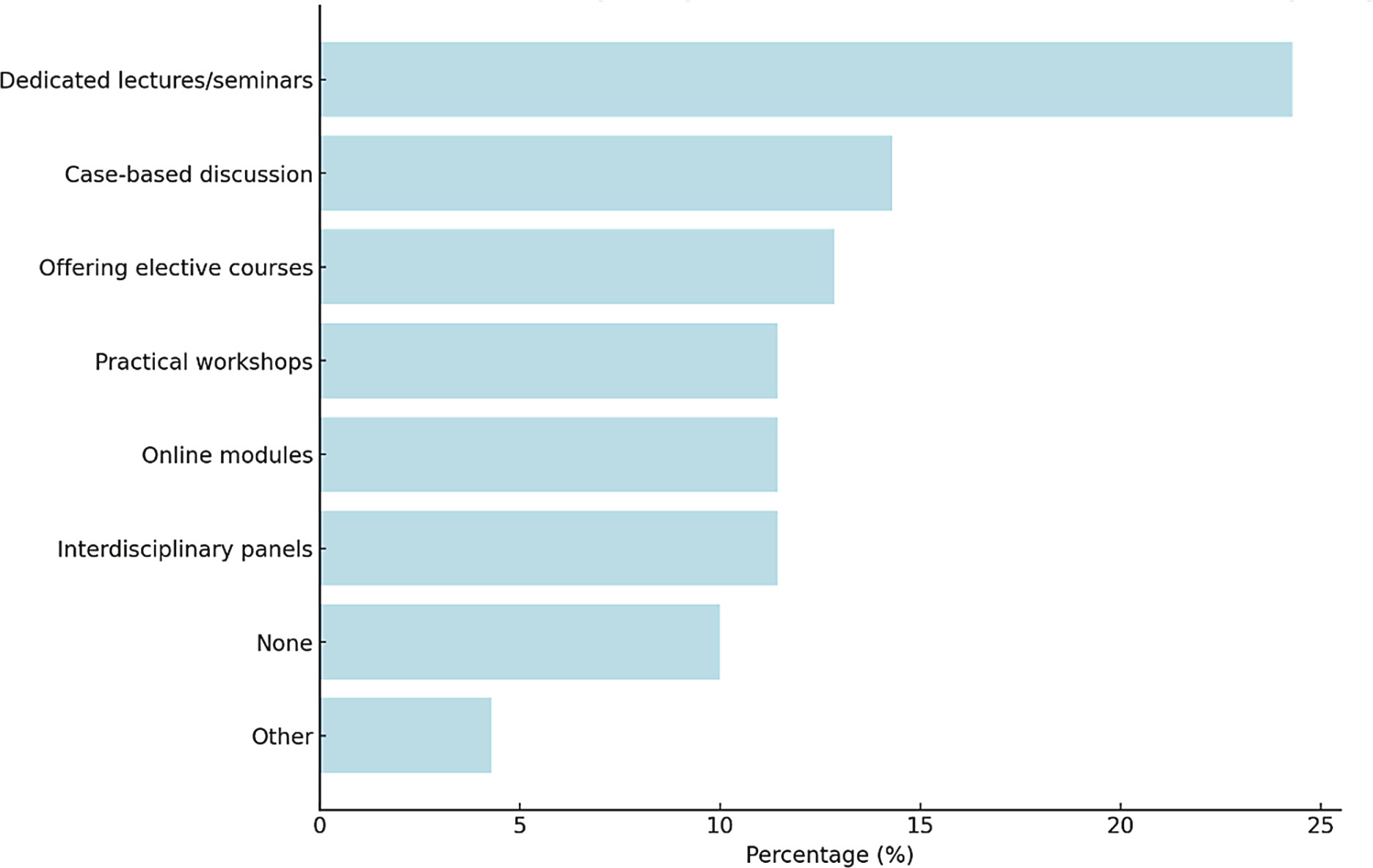
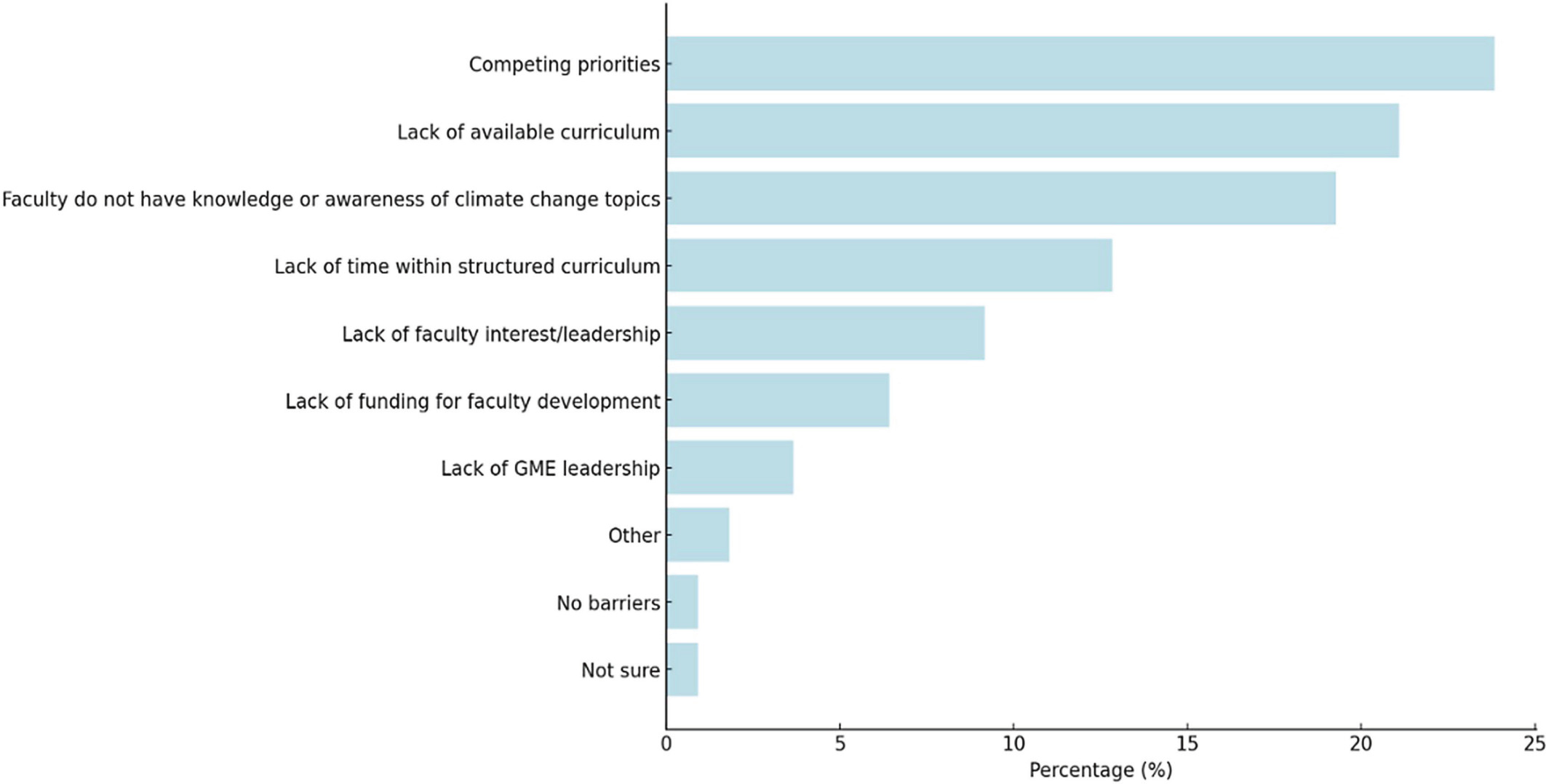
Respondents rated the most important educational topics in relation to climate change to be cancer (44%), food and water security (38%), and health disparities and inequities (30%). The preferred methods and challenges for incorporating climate health education are demonstrated in Figures 1 and 2.
Perceptions Around Climate Change
The survey revealed moderate agreement regarding the importance of climate change (mean 3 ± 1.2) and sustainability (mean 3 ± 1.3) for radiation oncologists. The relevance of climate change in addressing health equity also received a mean score of 3 ± 1.2.
Perceived Relationship Between Climate Change and Patient Care
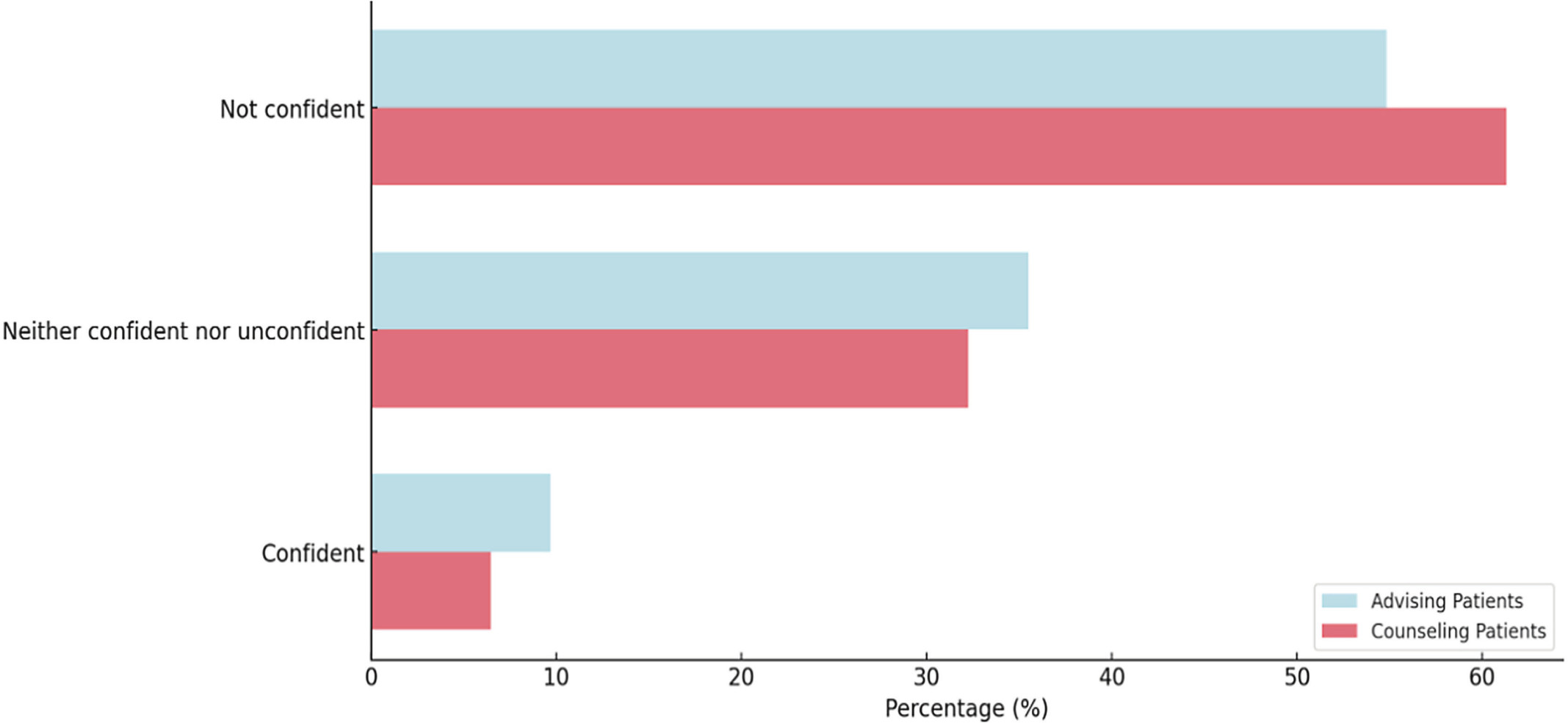
While acknowledging the impact of climate change on patients (mean 4 ± 1.1), most respondents doubted the necessity for radiation oncologists to discuss these issues with patients (mean 2 ± 1.5). Only 6% of respondents felt sufficiently prepared to counsel patients on the health impacts related to climate change, whereas 10% expressed confidence in advising patients on protecting themselves against climate-related health impacts (see Figure 3).
Impact of Educational Sessions on Attitudes Toward Climate Change
Using ANOVA, significant differences were observed in attitudes toward climate change and sustainability curricula among groups defined by their participation in prior educational sessions (P < .05). Key areas where notable disparities emerged included the perceived urgency of addressing climate change in residency curricula, the importance of sustainability in the practice of radiation oncology, willingness to incorporate related materials into educational curricula, and perceptions of faculty interest in these topics among PDs/APDs (Table 2).
| QUESTIONS | ALL RESPONDENTS n = 36 MEAN ± SD | PRIOR EDUCATION n = 22 MEAN ± SD | OFFERED EDUCATION, BUT DID NOT ATTEND n = 5 MEAN ± SD | NOT OFFERED EDUCATION n = 4 MEAN ± SD |
P VALUE (t TEST) |
|---|---|---|---|---|---|
| Climate change is an important issue for radiation oncologists | 3 ± 1.2 | 3.5 ± .9 | 2.2 ± 1.5 | 3.0 ± 1.1 | 0.26 |
| Climate change is an important issue for addressing health equity | 3 ± 1.2 | 3.5 ± .9 | 2.4 ± 1.5 | 3.0 ± 1.0 | 0.37 |
| It is important to address climate change and its health impacts in the core radiation oncology residency curriculum | 2 ± 1.4 | 3.2 ± 1.0 | 1.0 ± .0 | 2.8 ± 1.3 | 0.01 |
| Sustainability and health care decarbonization is an important issue for radiation oncologists | 3 ± 1.3 | 3.5 ± 1.0 | 1.6 ± 1.3 | 3.0 ± 1.2 | 0.05 |
| It is important to address sustainability and health care decarbonization in the core radiation oncology residency curriculum | 2 ± 1.3 | 3.3 ± .8 | 1.8 ± 1.6 | 2.4 ± 1.1 | 0.22 |
| Climate change currently impacts population health outcomes | 4 ± 1.1 | 3.8 ± .4 | 2.6 ± 1.2 | 3.3 ± 1.0 | 0.25 |
| It is important for radiation oncologists to bring the health impacts of climate change to the attention of their patients | 2 ± 1.5 | 2.8 ± .8 | 1.2 ± .4 | 2.7 ± 1.6 | 0.12 |
| I would be willing to make time in the curriculum to discuss climate change and sustainability if educational materials were provided | 2 ± 1.5 | 3.3 ± 1.0 | 1.0 ± .0 | 3.2 ± 1.4 | 0.01 |
| I believe residents would be interested in learning more about climate change and its health impacts | 3 ± 1.1 | 3.3 ± .8 | 2.2 ± 1.5 | 2.9 ± 1.0 | 0.35 |
| I believe other faculty, in addition to residents, would be interested in learning more about climate change and its health impacts | 2 ± 1.1 | 3.0 ± .8 | 1.4 ± .5 | 3.0 ± 1.0 | 0.01 |
Comparative Analysis Based on Session Attendance
Further investigation with post hoc LSD tests (a method used to find differences between group means) showed significant differences among 3 groups: those who attended educational sessions on climate change, those who were offered but did not attend, and those who were not offered any education on the subject (P < .05). Specifically, participants who had not been exposed to education on climate change demonstrated significantly lower levels of acknowledgment regarding the importance of climate change and sustainability within their professional domain.
Perceptions of Climate Change and Sustainability
Similarly, the study revealed that recognizing the significance of climate change and sustainability affects various perceptions, such as equity in responses, the urgency of incorporating these topics into residency curricula, the fundamental importance of sustainability, and the necessity for radiation oncologists to engage in discussions about these issues with patients (P < .05). Further analysis using post hoc LSD tests showed that those who deemed climate change and sustainability important were also more likely to express concern about related topics.
Perceptions Across North America
Finally, the impact of location (Canada vs the United States) on responses was evaluated using chi-square analysis. A higher percentage of Canadian respondents, compared with their United States counterparts, indicated a willingness to integrate climate-related material into residency curricula if such material was provided (66% vs 42%, P < .05). However, for the other questions posed in the study, there were no significant differences in responses between the 2 groups.
Discussion
This study provides insight into the attitudes and opinions of radiation oncology PDs and APDs in the United States and Canada regarding the integration of climate change education into radiation oncology GME. This investigation is particularly timely, given the growing recognition of climate change’s impact on health care delivery and patient outcomes, especially in specialized fields like radiation oncology. The broader trend toward environmental consciousness in health care, as demonstrated by findings from a national study, highlights the importance of incorporating climate change education and sustainability practices into radiation oncology curricula, aligning with the evolving priorities of medical professionals across the nation. 9
A significant finding from this study is the discrepancy between the recognized importance of climate change impacts on patient health and the low priority given to integrating climate change content into radiation oncology residency curricula. This divergence suggests a gap between awareness and action within the field. The AMA’s support for climate change education, echoed by organizations like the American Society for Radiation Oncology (ASTRO) and American Society for Clinical Oncology (ASCO), contrast with our findings of a tepid interest from RO educational leaders (PDs and APDs), underscoring the need for a broader cultural shift within the specialty. 16,23,24
Notably, the study revealed that those with prior education or acknowledgment of the significance of climate change were more likely to integrate this knowledge into their medical practice, including finding opportunities to reduce their own “clinical footprint.” However, the survey did not detail the nature of this prior education—such as venue (eg, conferences or CME), format (online or in-person), timing, or session quantity. Despite this, given the wide range of educational opportunities offered by numerous institutions, from formal lectures to informal discussions, the authors inferred that respondents may have participated in such activities.25-27 This finding suggests that the route to incorporating climate change education into radiation oncology may lie in alternative educational avenues outside the traditional GME structure. CME programs, for instance, could offer targeted courses linking climate change and radiation oncology, as evidenced by previous successful programs. 25-28 Conferences also provide an expansive platform for workshops, lectures, and panel discussions. Furthermore, the success of platforms like the Radiation Oncology Education Collective Study Group (ROECSG) and Diversity, Equity and Inclusion in Radiation Oncology (DEIinRO) in delivering accessible, customized educational content indicates a promising avenue for disseminating information on climate change and radiation therapy. 29,30
However, the integration of climate change education into GME remains a crucial long-term objective. The disproportionate impact of climate-related events, such as wildfires, on vulnerable populations and the subsequent exacerbation of health care disparities highlight the urgent need for comprehensive training in this area within oncology. 2,6,31 Such education would not only inform residents about the interplay between environmental factors, public health, and social equity but also empower them to make environmentally conscious decisions in their future clinical practices. Nevertheless, the barriers to implementation highlighted by the survey, such as competing priorities and the need to train and provide educational material to faculty, must be acknowledged and addressed. One approach to bridge these gaps could be the integration of new materials into supplementary didactic sessions rather than embedding them directly into the core radiation oncology curriculum. This strategy could help manage the challenge of overburdening the core curricula while still educating residents on the importance of these topics. Potential pathways for such integration could involve collaboration with professional radiation oncology bodies, educational committees, or accreditation organizations to develop and disseminate such material. The existence of third-party organizations, such as Climate Resources for Health Education (CRHE) 32 , which are already dedicated to providing educational materials for health care professionals, could facilitate this process and lessen the burden on institutions to develop new content.
The study is subject to several limitations, such as potential response bias and inadequate geographical representation. Certain confounding factors and historical elements, such as regional susceptibilities to climate events, add additional complexity to interpreting the presented data regarding patient vulnerability to climate-related interruptions of care. Additionally, the results may be influenced by social desirability bias, with respondents possibly overestimating the importance of climate change to align with perceived socially acceptable views. The inability to thoroughly analyze the impact of location on survey responses because of the small sample size as well as the structure and phrasing of the survey may both bias responses and limit the interpretation of the findings. Finally, while the response rate is low and limits the generalizability of our study, it is comparable to other studies on this topic.10,12-14 Despite these limitations, the findings offer meaningful insights from leaders in radiation oncology education, shedding light on both the facilitators and obstacles to integrating climate change education within the field. In response to the feedback received, we recommend future surveys specifically address the nuances of integrating climate change topics into the core radiation oncology curriculum. This could involve a careful distinction between the addition of discrete didactic sessions and the broader implications of embedding such content as a core component, thereby ensuring a more nuanced understanding of stakeholders’ willingness and the practical challenges involved.
Conclusion
In conclusion, while the study indicates a degree of reluctance within the radiation oncology community to prioritize climate change education, it also points to alternative pathways and the need for a multifaceted approach to incorporate this critical subject into the curriculum. The integration of climate change discussions into health care education, particularly in specialties like radiation oncology, is not just a matter of academic interest but a necessity to prepare health care professionals for the challenges posed by a changing climate. Through dedicated efforts to embed these topics into medical training, there is an opportunity to shape a generation of radiation oncologists who are not only skilled clinicians but also informed and proactive in addressing environmental challenges and the associated impact on patient care.